


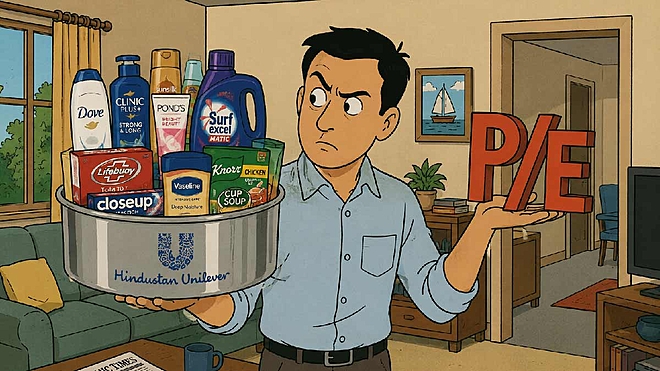
 Anand Kumar/AI-Generated Image

Summary: HUL is a business most of us trust without thinking twice. But trusting the business and paying any price for the stock are two different things, and this piece uses HUL's own numbers to show exactly where that line sits.
Look around your kitchen or bathroom and you'll probably spot a Hindustan Unilever product: Surf, Lux, Dove, Brooke Bond, Horlicks, you name it. You don't need to read an annual report to know this business. It's exactly the kind of company Peter Lynch told investors to look for.
But knowing a company is good is only half the job. The other half is what you pay for it.
A good business, and a warning
Legendary investor Rakesh Jhunjhunwala once explained why companies like HUL trade at a premium. They grow steadily, earn high returns and hand cash back to shareholders, unlike heavy-industry businesses that keep asking for more money.
Later, he used HUL to make the opposite point. Its price ran so far ahead that the stock barely moved for close to a decade, even though the business kept performing well.
Both things were true at once. A good business deserves a premium. But even a good business can be priced too high.
The gap that did all the work
Here's HUL's story in one line: over the long run, profit grew at roughly 11 per cent a year. That's solid for a mature consumer company, yet nothing extraordinary.
Now compare that to what the stock did over the same period.
Price runs ahead of profit
HUL’s share price grew faster than its profits over a 10-year period
| Over a decade | Grew at |
|---|---|
| HUL's profit | About 11 per cent a year |
| HUL's share price | About 17 per cent a year |
A six-point gap sounds small. It isn't. Compounded over 10 years, those extra six points nearly doubled the return the business alone would have delivered. And this isn't a one-off; the same gap shows up whether you look at five years or 10.
Where did that extra return come from? Almost entirely from investors paying more for each rupee HUL earned. That shows up in one number: the P/E ratio, or the price you pay for a rupee of profit.
Soaring valuation
HUL’s P/E has ballooned nearly thrice between 2010 and 2021
| Year | P/E |
|---|---|
| 2010 | About 24 times |
| 2020-21 | About 70 times |
| 2026 | About 34 times |
In a decade, the multiple nearly tripled. The business got better, but its growth didn't triple; investors' willingness to pay for it did. That re-rating, not the profit growth, did most of the work on the way up.
Why a premium is fair
Not all 10 per cent growth is equal. Picture two companies, both growing profit at 10 per cent a year.
The first barely needs to reinvest, so it hands most of its profit back to you. The second has to plough almost everything back in just to keep pace. Same growth on paper, but very different value in your pocket.
HUL is the first kind: strong brands, steady demand, low debt, and cash that actually shows up. Investors are right to pay up for that. The real question isn't whether to pay a premium; it's how big a premium makes sense.
When the premium became the whole story
Trouble starts when your return stops coming from the business and starts depending on the next buyer paying an even higher price.
At a P/E near 70, that's roughly where HUL stood. New investors weren't just paying for great brands anymore; they were betting someone later would pay even more for the same profits.
Eventually, that bet stopped paying off. Over the last five years, the stock went nowhere. In fact, it even slipped while profits kept climbing. The business didn't break; it still generates plenty of cash. The valuation simply came back down, from around 70 times earnings to about 34. The same mechanism that flattered returns on the way up worked in reverse on the way down.
So when is a high P/E worth it?
The lesson from HUL isn't ‘avoid expensive stocks’. It's more useful than that: a premium can be earned, but it can't be unlimited. The mistake isn't paying more for a better business; it's assuming a great company can never be a bad price.
Before you pay up for quality, ask yourself one question: What's your return if the P/E never rises again?
Work out what you'd make from profit growth and dividends alone, with today's multiple frozen in place. If the stock only looks good because you're counting on someone else paying more later, you're not investing in the business, but hoping for a re-rating.
A few more questions worth asking: How long can this growth last? How much cash does the company need to burn to produce it? How safe are those future profits?
Answer those honestly, and the price will speak as clearly as the brand names already sitting in your kitchen.
Want help figuring out the right price for a quality stock?
Value Research Stock Advisor gives you research-backed buy/sell/hold calls on high-quality businesses, with a clear view on valuation, not just business quality.
Subscribe to Stock Advisor today
Ask Value Research 
 New episodes every Friday












 New Process Alert
  Seems like you've uploaded a wrong QR code. Please upload the QR code downloaded from MF Central platform.


