


 AI-generated image
Gold and debt both serve as defensive assets, yet play distinct roles in a portfolio. Gold acts as a hedge and a diversification tool, while debt ensures drama-free returns, more or less.
But when markets hit rough waters, how do they react? Let's find out.
Current scenario
Although the Sensex has sunk around 11 per cent since September 26, 2024, gold has kept its nose above at 13.2 per cent.
On the other hand, debt funds, like short-duration funds, have offered a modest but steady 2.5 per cent return.
Clearly, gold has held its ground well this time. But has that always been the case?
The below table compares the return of gold and short-duration debt funds whenever Sensex fell 20 per cent or more in the last 20 years.
How gold and debt funds react to serious market falls
We only look at instances when the Sensex fell over 20 per cent
| Period | Sensex TRI (%) | Gold (%) | Short-duration funds* (%) |
|---|---|---|---|
| 10-May-06 to 14-Jun-06 | -28.9 | -17.0 | 0.6 |
| 09-Jan-08 to 09-Mar-09 | -54.8 | 32.4 | 9.6 |
| 08-Nov-10 to 20-Dec-11 | -23.8 | 33.2 | 9.2 |
| 30-Jan-15 to 11-Feb-16 | -19.6 | 7.1 | 6.3 |
| 15-Jan-20 to 23-Mar-20 | -37.8 | 2.9 | -0.8 |
| *Category average considered for regular plans. | |||
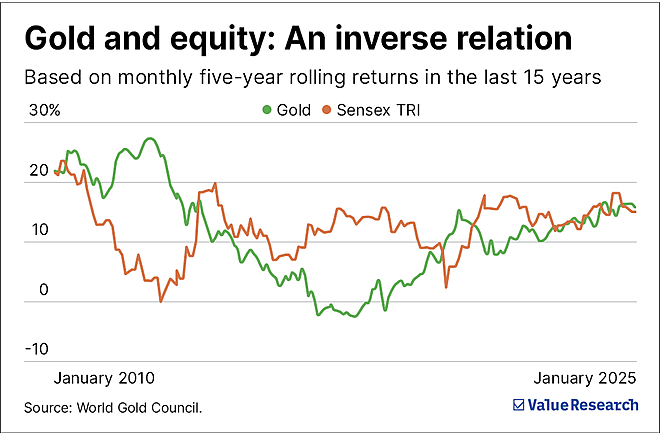
Except for one instance (the 2006 market fall), gold has consistently provided a safe haven when equities rattled investors (also see the below graph depicting this inverse relation between gold and equity).
Short-duration funds , though not as dazzling as gold, have still played their part, offering much-needed stability amid market turmoil.
So, does this mean gold is the ultimate safe haven? Not so fast! Before jumping to conclusions, let's take a step back and look at the full picture.
Beyond the crash phases?
Gold has shown its strength during market crashes, no doubt. But crashes don't happen every day! The real question is—how does gold behave between those rare meltdowns?
For this analysis, we will examine daily 10-year rolling returns over the past 10 years for gold, short-duration funds and the Sensex. The table below summarises the key outcomes:
| Parameter | Sensex TRI | Gold | Short-duration funds |
|---|---|---|---|
| Average return (%) | 12.2 | 9 | 7.8 |
| Maximum return (%) | 18.2 | 15.6 | 8.8 |
| Minimum return (%) | 5.6 | 3.3 | 6.4 |
| % of times return was less than 5% | 0.00% | 9.80% | 0.00% |
| % of times return was between 5% to 10% | 25.00% | 56.00% | 100.00% |
| % of times return was greater than 10% | 75.00% | 34.20% | 0.00% |
| Source: World Gold Council (for gold returns).Category average returns (regular plans) considered for short-duration funds. | |||
Our observation
-
Over a 10-year rolling period, gold's average return has fallen between that of the Sensex TRI and short-duration funds. The Sensex TRI has outperformed Gold 71.5 per cent of the time, with an average margin of 3.2 percentage points.
-
Gold's returns have varied significantly over time, with a wide gap between its highest and lowest 10-year returns, similar to the Sensex. In contrast, short-duration funds have maintained a much narrower range, offering greater stability and predictability.
-
Gold may have its moments of glory, but it doesn't always shine. Its 10-year returns have been below 5 per cent one-tenth of the time and under 10 per cent two-thirds of the time. Only in 34 per cent of the periods has the yellow metal delivered returns exceeding 10 per cent.
- Short-duration funds are the definition of consistency—100 per cent of the time, their 10-year returns have stayed between 5 to 10 per cent. No wild swings, no drama—just steady, predictable growth. Compared to gold's rollercoaster ride, they're more safe and stable.
Additional inputs
-
Gold isn't the ideal choice for stability. If stability—especially for short-term goals—is your priority, debt funds, such as short-duration funds, are the better option.
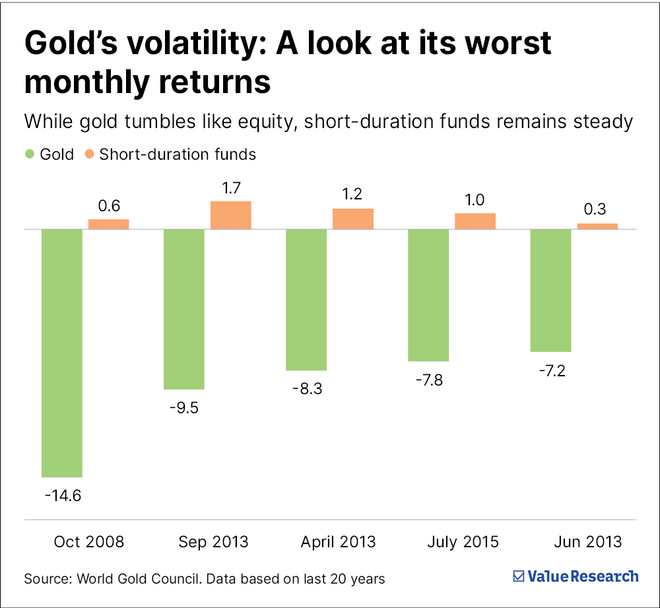
The graph below highlights gold's riskiness, showcasing its worst monthly returns over the past 20 years and its potential for significant negative returns.
- While gold's long-term average return has been strong, it also includes phases of sub-par, stagnant and even negative returns. For example, from January 2012 to December 2018, gold only delivered an annualised return of 1.39 per cent—barely beating what you'd get in a savings account, let alone an FD (fixed deposit). In that same period, the Sensex and short-duration funds returned 14.5 per cent and 8.2 per cent annually, respectively. So, if you're thinking of adding gold to your portfolio, remember: think long-term.
Our take
Since gold has the potential of giving inflation-beating returns in the long run while holding well during equity meltdowns, one might consider allocating 5-10 per cent of their portfolio to this asset. But keep in mind the volatility that comes with it.
Last but not least, for steady returns within a more predictable range, short-duration funds remain a better option.
Also read: International ETFs: A golden opportunity or a premium trap?
Ask Value Research 

 New episodes every Friday




 New Process Alert
  Seems like you've uploaded a wrong QR code. Please upload the QR code downloaded from MF Central platform.


