


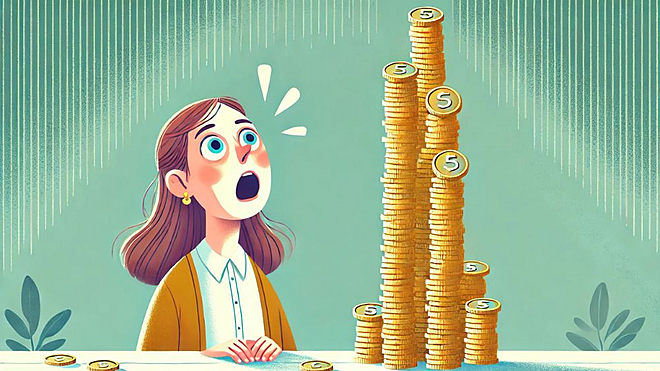

The title of this article might sound absurd. Make crores without investing anything more? But hear us out. This isn't clickbait - it's a mathematical reality.
The journey to the first crore is one of the toughest financial mountains most people will ever climb. Let's read the story of Suman.
The long road to first crore
Suman started her investment journey at 25. Disciplined and forward-thinking, she invested Rs 10,000 every month through SIPs religiously, without fail.
Even with 12 per cent annual returns (a reasonable expectation from a good equity portfolio), it took her 20 years to reach Rs 1 crore. That's over two decades of patience and resisting countless temptations to dip into investments.
Even at higher monthly investments, it would have taken her a decade-plus of dedicated investing.
| Monthly investment | Time taken to Rs 1 crore |
|---|---|
| Rs 10,000 | 20 years |
| Rs 20,000 | 15 years |
| Rs 30,000 | 12 years |
| Rate of return assumed is 12 per cent. | |
Life happened, but the money kept growing
By the time Suman reached her first crore, life looked dramatically different. In her mid-40s, life has thrown new financial curveballs - a hefty home loan EMI, her child's rising education fees and ageing parents who needed support.
With these rising expenses and limited income, Suman even thought of dipping into her hard-earned Rs 1 crore investment for her wants. The temptation to withdraw just a small portion of her corpus was strong. But she resisted.
However, continuing to do her SIP seemed increasingly difficult. That said, we always advise against stopping SIPs completely. Ideally, Suman should have continued investing whatever amount she could manage - even if it meant reducing her monthly SIP amount. Every bit helps. But even if her circumstances made fresh investments impossible, her existing corpus still had tremendous growth potential on its own.
"I can't put away anything more right now," Suman thought. "Does this mean my wealth-building journey is on pause?"
Far from it. In fact, this is where things got interesting for her.
Money making money
Once Suman's portfolio hit Rs 1 crore, her money started working overtime. She decided to leave that hard-earned crore untouched, continuing to earn that same 12 per cent annually. Here's what happened:
| Time taken | Corpus |
|---|---|
| 0 (Present) | Rs 1 crore |
| 6 years | Rs 2 crore |
| Next 4 years | Rs 3 crore |
| Next 2 years | Rs 4 crore |
| Next 2 years | Rs 5 crore |
After six years, Suman's Rs 1 crore became Rs 2 crore. And her third crore arrived within four years later, with no additional investments.
The acceleration wouldn't stop there. The fourth crore would arrive in just two years later, and her fifth crore would take another two years to materialise.
What had initially taken her 20 years of monthly investments to achieve was now happening in increasingly shorter intervals, setting her up for a comfortable and financially secure retirement. While the first crore took her two decades, the next four crores can be made within 14 years, provided her investment grows 12 per cent annually.
But what if the returns were lower
?
Let's say Suman's portfolio managed a more modest 10 per cent annual return. Her Rs 1 crore doubles to Rs 2 crore after seven years and triples to Rs 3 crore four years later. Even at a slower pace, she would make a couple of crores in over 11 years' time.
Sure, it takes a bit longer, but her wealth still multiplies significantly - and again, without her adding a single rupee.
How does Suman's wealth multiply?
All thanks to the
power of compounding
. Your money makes more money, which then makes even more money, creating a snowball effect that accelerates over time.
It can be explained mathematically using the compounding formula:
Corpus = Principal x ( 1 + r)t
where r= rate of return (in per cent)
t= time period (in years)
Thus, the higher your principal amount and rate of return, the higher your corpus and the less time it takes for your wealth to grow exponentially.
Leave your wealth alone
The hardest part of this strategy isn't mathematical; it's psychological. When you see a crore sitting in your account, the temptation to use some of it can be overwhelming.
Several times, Suman felt tempted to withdraw 'just a little' for a luxury car.
"It's just Rs 15 lakh for the car - barely 15 per cent of my corpus," she reasoned with herself. "I've worked hard; don't I deserve to enjoy some of it now?"
Her friend showed her the numbers: A withdrawal of Rs 20 lakh from her crore would mean ending up with Rs 7.7 crore instead of Rs 9.6 crore after 20 years. That's nearly Rs 2 crore less in future wealth - all from one seemingly small withdrawal.
The lesson from Suman's journey? If you want to keep getting richer (and don't urgently need the money), it's best to stay invested and let compounding do the heavy lifting.
Also read: My gym trainer unknowingly taught me more about investing than most money gurus
This article was originally published on February 28, 2025.
Ask Value Research 

 New episodes every Friday







 New Process Alert
  Seems like you've uploaded a wrong QR code. Please upload the QR code downloaded from MF Central platform.


