


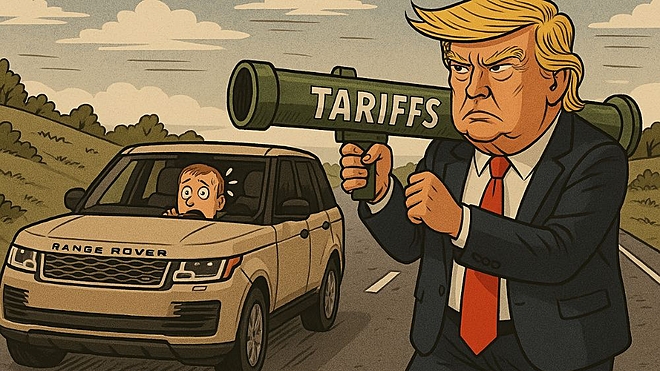
 AI-generated image

A week is a long time in politics. But if the first seven days of April are anything to go by, this should now hold true for businesses too. As Trump tariffs plunge world order in chaos, among the highest damage back home has been sustained by Tata Motors. With a 14 per cent drop, the automaker is the second worst-hit Sensex large cap in just the last week. The culprit is Trump's 25 per cent tariff on all automobile imports to the US, which hurts Jaguar Land Rover (JLR), Tata Motors' main money maker. JLR is Tata Motors' lifeblood, responsible for over 70 per cent of its revenue. And for the luxury car maker, the US is its second largest market making up nearly 15 per cent of its revenue pie and about a third of its overall volumes.
Naturally, JLR's move to pause all US exports for a month to assess the tariff impact has unnerved investors. The most material and likely outcome in the short-term is a drop in US sales and squeezed margins that would naturally trickle down to Tata Motors.
However, for better or worse, the automaker has more things to worry about than just the US tariffs. Beyond the US, JLR is dealing with a slowdown in other key markets. And the intense competition in the electric vehicles (EV) space, where Tata Motors is aggressively gunning for growth, are problems that could prove to be far more challenging.
What's worrying Tata Motors?
- Global auto slowdown: Apart from the US, JLR's global revenue engine is powered by two other geographies, Europe (26 per cent) and China (13 per cent), both of which are seeing a slowdown. The European passenger vehicle market has stalled in line with a slowing economy. As of February 2025, new car registrations were down 3 per cent from a year ago. Meanwhile, EVs are fast diminishing demand for traditional ICE (internal combustion engine) vehicles. Petrol car registrations in Europe were down over 20 per cent YoY as of February while diesel car registrations dropped 28 per cent. EV sales, on the other hand, leapt 28.4 per cent. JLR currently is predominantly present in ICE vehicles.
Similarly, JLR's China story is also one of retreat. Its exports were down 6 per cent till December 2024 over the previous year. Local sales (through its JV with Chery), meanwhile, were down 27 per cent YoY. As local consumers favor domestic EVs with cutting-edge tech, JLR's relevance is being re-evaluated in the world's largest auto market. - Risks in the EV story: The rising adoption of EVs, while positive for Tata Motors who's eyeing to turn its premium JLR line-up electric, also means much heated competition, especially from China. Chinese-made EVs alone accounted for 22 per cent of Europe's EV market in 2023, up from just 2.9 per cent in 2020—showcasing their aggressive rise amid the decline of ICE vehicles.
Back home where Tata Motors has long held EV market leadership is staring at similar disruption thanks to the government easing norms and import duties to lure global EV manufacturers. For instance, the sharp cut in import duties, from 110 to 15 per cent, on premium EVs priced above $35,000 last year is expected to facilitate entry of global giants like Tesla and China's BYD. This signals the beginning of a trend where policymakers could be handing out more incentives to global players.
At 46 per cent, Tata Motors is still holding the pole position in the domestic EV market but this is down from 72 per cent in 2023 due to competition from domestic peers. With global players now gearing up to enter the fray, the going will get tough for the car maker. - The shadows of capital missteps: Internally too, Tata Motors is grappling with strategic challenges. JLR has shelved its plans to produce EVs at Tata Motors' upcoming $1 billion plant in Tamil Nadu, affecting the timeline for the launch of its premium Avinya EV models, initially scheduled for 2024 but now delayed to 2026-27. This decision stems from challenges in achieving a favorable balance between the cost and quality of locally sourced EV components. However, after committing a massive sum of money, such hiccups are reminiscent of Tata Motors' past capital missteps (read JLR acquisition) and raise concerns about potential capital misallocation.
Roadblocks in the turnaround story
JLR's recent turnaround was impressively neat. Shedding off its debt load and improving EBIT margins to 7.8 per cent as of December 2024, up from near-zero just a few years ago, saw Tata Motors becoming a D-Street favourite. However, the last seven to eight months have knocked half the height off shares from July 2024 highs. Evidently, the market has caught up with the likely headwinds ahead; US tariffs being the latest addition.
The stock is trading at 12x earnings, much cheaper than peers like Maruti (30x). The discount, however, seems justified. Tata Motors remains highly exposed to geographies seeing a slowdown, while most domestic car makers are insulated given their India-focus.
The other key growth thesis for Tata Motors was its potential to lead India's EV revolution helped by its strong market share and regulatory protection. But with India opening up its borders to global EV makers, even this premise now demands a re-evaluation.
In short, Tata Motors is not facing a single storm. It's navigating three at once—US tariffs, competition in the EV space and local policy shifts have all converged. For investors, a wait-and-watch approach now seems most ideal.
Also read: Analyst's Diary: At 10x earnings multiple, is Tata Motors a steal?
Ask Value Research 
 New episodes every Friday












 New Process Alert
  Seems like you've uploaded a wrong QR code. Please upload the QR code downloaded from MF Central platform.


