


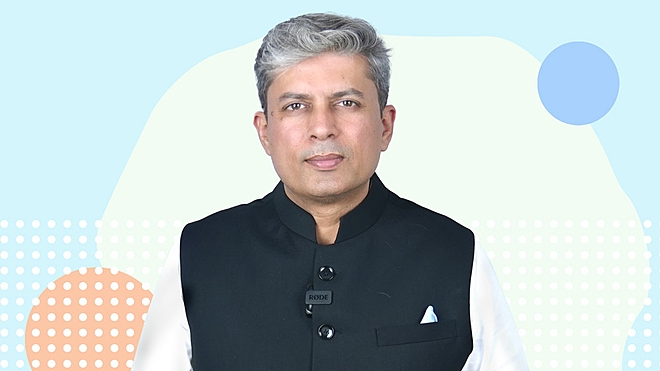

With 18 years of experience at the fund house, Abhishek Bisen is well-versed in navigating the market's ups and downs, including significant events like the 2008 Global Financial Crisis. The Head of Fixed Income at Kotak Mahindra Mutual Fund believes that a strong focus on risk management, liquidity and the fundamentals of debt securities is essential for effectively weathering market turmoil.
Bisen currently oversees 66 schemes at the fund house, including the four-star-rated Kotak Equity Hybrid Fund. In this interview, he shares his core debt investment strategy, highlighting the importance of liquidity and exit strategies. He also explains why India's debt market presents both "opportunity and stability" amid global uncertainty and RBI rate cuts and offers insights into how investors should approach the fixed-income component of their portfolios in today's market.
You have been at Kotak Mutual Fund for 18 years and have experienced events like the Global Financial Crisis and various credit crises. What are your key lessons from these experiences?
In short, there's only one lesson to be learned: risk management is paramount. If you can manage the small risks well, your job is done. Another thing that you need to focus on is liquidity because, as a portfolio manager, irrespective of whatever duration or mandate we have, at the end of the day, all our money is disposable on a T+1 basis. So, regardless of the asset's value, if liquidity is not in line with what the investor is looking at, it has no value for us, and one needs to be very careful about that.
Different crises come with their own sets of challenges. Can you give us examples of what you learned?
During that time, I learned that there are two ways to analyse markets. Firstly, if you look at just the trends or chase prices, you'll form a different view. On the other hand, if you look at the fundamentals and compare the prices, you will have a different view. So, nine out of 10 times, if you just look at the fundamentals and then the prices, your view formation will be much more correct and appropriate. Most of the time, what happens is that, typically, in bond markets, it's mostly about execution. They just form a view and leave it to the dealer. Usually, in the government bond markets, those times were extremely challenging or critical regarding how you executed your view of the markets. But if you go through the fundamental route and it's correct, your output will also be correct. It may not look like recency bias in the near term, which needs to be removed. Being right about recency bias doesn't mean it will help you; being wrong doesn't hurt you. So, discipline and understanding take a lot of time to build into your character and nature while taking a call on the markets.
What's your core strategy when selecting debt instruments? Do you follow a similar approach across all your debt funds?
As I said, with mutual fund portfolio managers, liquidity is of key importance irrespective of whatever value the asset is offering. First, we need to find the source of liquidity, as we will be providing it to the markets at the first level of execution. But once we are in, we want to get out, so we have to look at the exit routes. Whether the asset today is liquid or will remain liquid until we are in the asset because, typically, we operate in very long-duration assets. So, if you operate in very short-duration assets, the asset's maturity will provide liquidity, assuming it has a strong credit profile.
Typically, 95 per cent of a portfolio is very safe and sound in terms of rating. Thus, we don't need to get worried from that perspective. However, the problem arises if your asset maturities are too long and the asset is good. You might find yourself on the wrong side during an event like the one in 2013, an unforeseen event or whatever is happening today. Since you have no liquidity, your risk management and principles are key, and your core strategy must be unique.
With the RBI cutting rates to support growth and rising global yields, how do you view the Indian debt market? Are we in for a period of stability, volatility or opportunity?
I would go with opportunity and stability because the Indian market has shown extreme resilience. We are focusing entirely on local factors and not getting carried away with global noises. This is both an encouraging and promising development, demonstrating the central bank's credibility in effectively managing the entire market. This is because I come from a background where I have spent around two decades in the markets and have seen how markets used to function in the early 2000s and then in the mid-2010s.
There was a time when if the US markets used to move around by five basis points, Indian bonds would have shed at least seven to eight basis points or even more. But now, even when there has been a lot of volatility and movement overall, where the spreads between the Indian 10 years and the US 10 years were at 550 basis points, it is currently trading at 200 basis points. This reflects that domestic fundamentals have value, and Indian bonds truly reflect the domestic fundamentals as opposed to being just dependent on the US market.
Do you see the rate cut as a chance to lock in yields? How do you balance this with the risk of rising global yields impacting domestic bonds?
There are two perspectives: domestic and global. Usually, domestic investors look at the Indian yield on an absolute basis, and foreign investors look at it relative to other emerging market peers. For domestic investors, there are two key factors: stability and taxation. Regarding fixed income, we've struggled to persuade investors that volatility is not their enemy. Fixed deposits offer lower rates than the bond market, but that doesn't mean they're superior because they don't experience volatility.
Therefore, from this perspective, yields are declining, which is also reflected in the secular decline of long-term yields. The inflation rate, which has gone down to 4 per cent, is likely to stay in that zone, and as efficiency emerges in the economy, it may plateau at 4 per cent or decrease further. So, the yield differential between inflation and the long-term bond yield is 3 per cent, which is very attractive from a long-term investor's perspective. Therefore, investors should look to lock in before the yield differential decreases further. In the next three to four years, these long-term bond yields may decrease by 100 basis points.
Hence, the biggest risk an investor is running is investment risk. Suppose you are investing in a traditional manner; every two- to three-year cycle reverses, resulting in higher yields each time you reinvest. This may also not be true this time because inflation fundamentals are different, and inflation is unlikely to go higher over the medium term. The focus now shifts to global investors. There are different fundamentals and dynamics. Yields at the same level may or may not be appealing. But India is a promising story, and with the size and the growth opportunities we have, I believe a favourable amount of investment flow can come from developed markets to Indian bonds for long-term investors seeking capital protection with an upside of 2-3 per cent.
How should investors structure their asset allocation between fixed income and other assets in today's market?
This is a good question; it entirely depends on your risk-taking capability and investment objective. If you are young and equity markets see a decent amount of correction and value emerging, the portfolios can be skewed towards equities, even in mid and small caps. This is because the correction has brought in opportunities that are much more promising compared to the debt. But suppose you are somewhere around your 60s, whether retired or living on the portfolio income, irrespective of what value equities offer. In that case, your asset allocation has to be highly skewed towards debt because that's your bread and butter. You should not chase incremental alphas and be happy with fixed or low-volatile assets because that will bring peace of mind over time.
Also read: India's macro remains strong despite market correction: Invesco' Amit Ganatra
Ask Value Research 
 New episodes every Friday






 New Process Alert
  Seems like you've uploaded a wrong QR code. Please upload the QR code downloaded from MF Central platform.


