


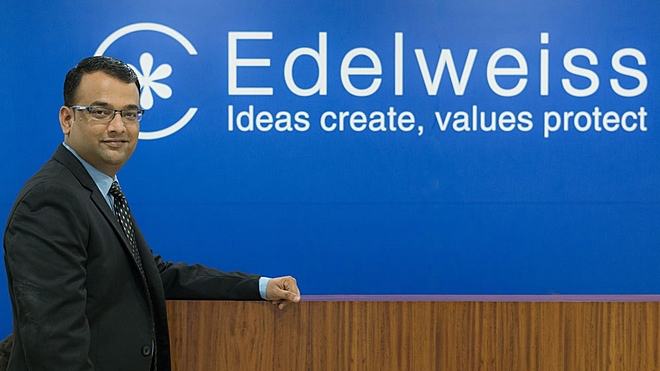


The Indian equity market remains in turmoil, largely due to Trump's tariffs and ongoing geopolitical tensions. Due to such uncertainties, Bhavesh Jain, co-head of factor investing at Edelweiss Mutual Fund, believes the market will rebound only in the second half of this year. He anticipates a structural recovery driven by a robust earnings rebound during that period. Jain also highlights that the benefits of RBI rate cuts, favourable crude prices and a rise in capex will only be reflected in the latter part of 2025, which is expected to fuel market recovery.
Currently, Jain oversees 27 funds at the AMC, including the Edelweiss Equity Savings Fund and the Edelweiss Large Cap Fund, both rated four stars by Value Research.
In this exclusive interview, Jain not only shares his views on the ongoing market volatility but also discusses the factor-based framework deployed by the Edelweiss Aggressive Hybrid Fund and the reasons behind its strong performance. He emphasises the importance of a multi-factor approach that incorporates momentum, growth, quality and value, as well as the significance of disciplined asset allocation for ordinary investors.
With US tariff measures causing market volatility, are we entering a consolidation phase, or can we expect a swift rebound?
We live in a fascinating time and think volatility will likely increase. The tariffs are the current issue, but they may soon shift to other things, such as Donald Trump's tweets on Iran and China. So, all these things will keep increasing the market's volatility. Given these issues, I think the structural recovery will only happen in the second half of the year when the market will start focusing on domestic factors.
We feel that earnings will also make a tremendous comeback in the second half of the year. Once earnings rebound, we will undoubtedly steer clear of the global noise and concentrate on domestic matters, as prices ultimately follow earnings. But until that time, our market may consolidate, and then we may see a decent run-up.
Given India's sluggish growth and geopolitical tensions, what factors could spark a recovery in Indian equities?
If you go back between March and September of 2024, our earnings were almost washed out due to the general elections, budget and subsequent state elections. We saw decision-making in government being extremely slow, and capex, which was primarily driven by the government, was lacking. But now that it has come back strongly, we see new orders coming up, which are likely to give a decent push to earnings. The RBI has already implemented numerous liquidity measures and may implement a few rate cuts. The benefits of these measures will begin to manifest in the second half of the year.
Overall, a return to government capital expenditure, strengthened decision-making, favourable crude prices, controlled inflation and lower interest rates is expected to boost earnings significantly. Once earnings recover, the focus on global events will decrease substantially, leading to a significant calm in our market.
The Edelweiss Aggressive Hybrid Fund follows a multi-cap approach on the equity side, driven by your factor-based framework built on Growth, Quality, Value and Momentum. In practice, which of these factors typically dominates the model's equity allocation? And does their dominance shift based on market cycles?
We have a fixed frequency of churning our portfolio in our aggressive hybrid fund or most factor-based funds. Most of our factors undergo a quarterly churn, with momentum being the dominant factor. This momentum-based factor helps us navigate between growth, quality and value because, at the start, we give equal weight to growth, quality and value. The dominating factor is momentum, which is combined with growth, quality or value. So, giving higher weight to momentum helps us navigate across market conditions because there will never be one factor that will keep dominating the markets.
Over the past few years, we have invested heavily in defence and capital goods stocks due to their strong performance. Now, when volatility has increased, we are buying some of the FMCG and consumption names. Therefore, we navigate through a multi-factor approach, with momentum overall being the most dominant factor. If you look at growth, quality, value, momentum, and low volatility, as well as the data for the last five, 10 and 15 years, momentum by far is the best-performing factor among all the factors. So, that is something that we use in our aggressive hybrid fund.
The fund has consistently delivered strong alpha over the last three years. To what extent can this performance be attributed to your factor investing framework? Could you share what worked particularly well during volatile phases?
In the aggressive hybrid fund, we have almost 75 per cent static allocation in equities and 25 per cent in debt. The fund's alpha is due to the equity portfolio over the last three to four years. This is because, in fixed income, we run a straightforward accrual-based strategy - investing in high-quality AAA-rated names that mature anywhere between three and five years. So, we don't make any durational or aggressive credit calls on the debt segment of the portfolio.
In equity, we predominantly use a multi-factor approach rather than relying on a single factor. This strategy has helped us consistently outperform in upward-trending and volatile markets. Thus, a multi-factor stock selection strategy dominates the portfolio. In the last couple of years, when value stocks performed well, we included them in our portfolios. Before the Covid-19 period, when growth and quality were doing well, our higher growth and quality weightage helped us generate a significant amount of alpha. This multi-factor approach reduces volatility without sacrificing the upside. So now, when you look at our aggressive hybrid fund returns for the last three- and five-year periods, they outperform even a large-cap category, which is 100 per cent in equities. We are outperforming that category with just 75 per cent of the equity. So, our volatility is lower, and our returns are almost equal to or slightly better than the large-scale category.
What basic portfolio construction rules would you recommend for an average retail investor?
The first rule is having a proper asset allocation. Avoid concentrating all your investments on a single asset and instead strive for a well-diversified portfolio. Secondly, ensure that your portfolio has adequate liquidity. You should avoid keeping emergency funds in any lock-in financial product.
So, don't invest all your money in real estate or fixed deposits (FDs), which are hard to liquidate. Typically, investors tend to follow the flavour of the season investment style. Last year, we saw several new launches based on the defence theme after they had already delivered 100 per cent returns. If investors have invested in such categories, they will definitely see a 20-30 per cent drawdown, which has happened in a few cases. One should take expert advice and not chase momentum blindly. Even if you invest in momentum, it is better to do so in a diversified rather than a single-sector portfolio. However, most investors can look at simple products through SIPs, which will generate a reasonable amount of wealth for you over time. Investors should also not go for extra returns by taking unwanted risks.
The final advice would be never to take shortcuts. Don't fall for any idea or strategy that will promise you a 100-200 per cent return in one year. There is no shortcut for success, so one has to stay invested and focused. Be patient with equity investments. They are volatile, and there will be some or other issues in the market, which will bring a lot of volatility in the short term. Still, if you are disciplined and stay invested long, you will hardly hit a negative return.
Also read: The Indian debt market has shown extreme resilience: Kotak Mahindra AMC's Abhishek Bisen
Ask Value Research 

 New episodes every Friday










 New Process Alert
  Seems like you've uploaded a wrong QR code. Please upload the QR code downloaded from MF Central platform.


