


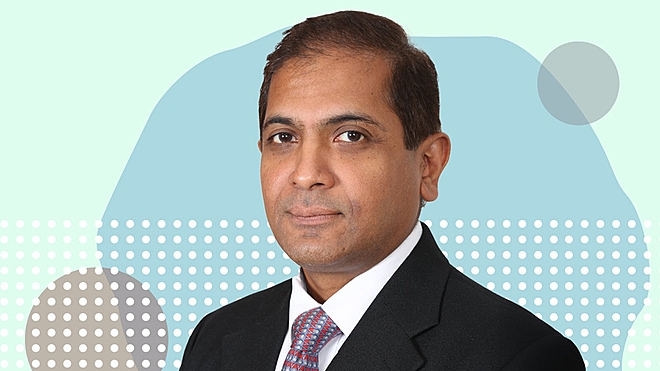

Amid significant volatility in the Indian equity market over the past few months, many investors are uncertain whether the worst is yet to come. However, Venugopal Manghat, CIO at HSBC Mutual Fund, is confident that "we've seen the worst in price" and believes the market has reached its bottom. While he remains optimistic about India's economic growth, Manghat cautions that ongoing volatility may persist due to global uncertainties and elevated valuations in certain pockets.
Currently, Manghat oversees seven schemes at the AMC, with a combined AUM (assets under management) of Rs 45,383 crore. Of these, the HSBC Flexi Cap and HSBC Value Fund have earned four-star ratings from Value Research.
In this interview, Manghat shares his views on the current state of the Indian market, his investment philosophy, and why HSBC Mutual Fund follows a "bottom-up investing" approach. He also discusses the factors behind the excellent performance of the HSBC Small Cap and HSBC Value Fund, as well as the steps he plans to take to improve the performance of his underperforming equity funds.
With the Sensex down 13 per cent and mid and small caps facing steep declines, do you think the worst is behind us, or should investors brace for more volatility in the near term?
Firstly, the markets have corrected significantly. We've observed a continuous correction lasting about five months. The mid- and small-cap indices have decreased by approximately 27-28 per cent. Individual stocks have experienced a more significant correction, with some seeing nearly 30-50 per cent declines. Therefore, valuation excesses and some earnings cuts have been removed from the system. So, from a fundamental perspective, the markets are getting close to a bottom or have bottomed out. However, I cannot say if this means volatility will decrease in the future as global conditions remain uncertain. For example, the world markets will be impacted if the US market corrects even more from its current levels or its economic scenario worsens. India will probably be a part of that. So, I guess volatility could continue for some more time, but for now, we've seen the worst in price, and therefore, the markets have, in our view, bottomed out.
After the recent correction, do you think Indian equities are now attractively priced, or are they still trading at a premium?
Well, the markets have corrected a fair bit. But given the rally we saw in the previous two years and the high valuations it had taken the individual sectors or stocks to, from a historical perspective, valuations continue to be slightly higher in some pockets. In some cases, they have also corrected; for example, in Capital Goods, some stocks have corrected to below-historic levels. The relative valuations of Financials remain low within this market. Similarly, on a bottom-up basis, you see stocks priced lower than in past cycles. On the long-term average, the valuations have become more attractive. Some have become fair or closer to their long-term averages. However, some continue to be expensive and may experience further price adjustments. If the market turns, those valuations might align more closely with the growth expectations of these companies. In part, I believe the correction of valuation excesses has improved the market's outlook.
Can you explain your core investment philosophy and how it adapts to different market cycles - especially during uncertain times like these?
The investment approach and strategy remain unchanged. As a fund house, we actively seek high-quality businesses and companies. These companies should possess high integrity, vision and drive to propel the company forward. Therefore, we always look for high-quality companies at reasonable valuations. Higher returns and a higher alpha can, of course, result from buying at a lower valuation.
What have we done during these economic and earnings growth forecast cuts? We've looked at expensive stocks, having cut the numbers and then stress-tested them to see if the valuations remain expensive. In such cases, we have cut down exposures in some sectors where we were very overweight. Overall, within the high beta sectors across all the funds we run, wherever it was required, we've cut down that a little bit, given that the current year is a little uncertain with the global setup. We continue to monitor the progress of the economic recovery, so we have moderated some of these exposures accordingly. However, apart from that, the basic thought process remains the same. We have always been bottom-up and active investors. We are long-term investors who are constantly looking for ideas. Despite the market volatility, those aspects of our patient investment remain unchanged.
The HSBC Value and Small Cap Funds have consistently ranked among the top performers over three, five and 10 years. What key investment decisions and market factors have driven this success?
We have remained true to the label. As I mentioned, we have been completely bottom-up in our approach to investing. At all points, our focus has been to identify good companies and stay invested for long periods. The portfolio turnover ratios for these funds have been on the lower side, reflecting that we remain invested in companies for long. I think the quality of stock picking - our research - has been the key reason for the outperformance. So, we remained true to the label and continued our thought process despite market turbulence, which rewarded us over the longer term. Those are the key reasons I think the fundamental research effort we put in helped us in this journey over the last many years.
Many of HSBC AMC's equity funds thrived in 2024. What were the key contributors, and how much of a role did momentum-driven stock picks play?
I don't think we've played momentum at all. We were convinced by an investment theme that powered the market during most of the bull run over the past two to three years. We invested in companies that outperformed the market. That's what has led to the
strong performance of our equity funds in 2024, and we've continued to remain invested in many individual stocks for long periods. For instance, the portfolio churn in our small-cap fund is significantly lower than the category average or the other funds in the same category. So, we have remained invested in the picks generated through our research effort, and we've not changed momentum or made any short-term moves to generate alpha. We've always remained long term and identified the best companies that can generate alpha over time.
But most of HSBC's equity funds started 2025 in the bottom quartile. What led to this dip, and what changes are you making to turn things around?
We have been making some moderations; we were significantly overweight and underweight. Additionally, it's important to note that the market has corrected substantially. It's a complete reversal from the trend we've seen over the last two to three years. The market has reversed in less than 40-50 days with absolute ferocity.
Most stocks are down by 30-50 per cent. The biggest hit came in February and, to some extent, even at the start of March, and that has played a role in the underperformance. We've always been more exposed to the broad market, as we've always believed that stock picking would deliver a higher alpha, and we've stuck to that strategy. We have been bottom-up in our approach to investing, so we have a higher exposure to the broader markets.
The increased exposure to mid- and small-cap stocks, as well as certain themes that performed well over the past few years, has reversed in the last 40-50 days, leading to a slight decline in performance. But we continue to believe that if India has to grow at 6.5-7 per cent, there must be some leaders and contributors to the growth.
One theme that performed well over the last two years will continue, and consumer discretionary will deliver. However, we are now balancing the portfolio with some underinvested sectors and reducing exposure to overexposed sectors. But we remain optimistic about many of these drivers, including investments, consumption and financialisation. I think those themes will continue to drive India's growth and consequently lead to earnings growth. Over the next several years, they will reap even greater rewards.
Following the recent market downturn, which sectors or investment themes do you find attractive from the medium-to-long term, and which still seem overvalued despite the correction?
On a shorter-term basis, the financial space looks relatively better from a valuation perspective. Some of that has already played out, but even now, valuations are reasonable on a medium-term basis. So, I would still be quite optimistic about the investment theme. There are enough opportunities for India to grow; for India's growth, you need high-quality infrastructure. Much must be done to reach a higher level of quality infrastructure globally. Without that, our competitiveness will remain low compared to China or other competing economies. So, infrastructure is again a medium-term positive opportunity.
On a long-term basis, I am highly optimistic about Consumer Discretionary. With a population of 140 crore and an average age of 28, the per capita income is close to $2,800 and is expected to rise to $5,000 over the next seven years. That's a dream setup for investors to take advantage of such opportunities. So, the consumer discretionary space will give you the best alpha across the consumption space. A significant portion of the unorganised market is transitioning to the organised sector. This is a giant opportunity; I expect some of these companies to become much larger in size and scale by 2030. I believe the indices will likely include more stocks from the consumer discretionary space within the next five to seven years. Therefore, we are highly optimistic about this sector in the long run.
Also read: Interview with Rupesh Patel, Senior Fund Manager at Nippon India Mutual Fund
Ask Value Research 
 New episodes every Friday











 New Process Alert
  Seems like you've uploaded a wrong QR code. Please upload the QR code downloaded from MF Central platform.


